


Meet Our 2026 Scholarship Recipients

The Land Conservancy of New Jersey is proud to have the largest environmental scholarship program in the state, and one of the largest in the nation. We just awarded TEN scholarships in the amount of $10,000 each. This program has come a long way, starting in 1983 with the Russell W. Myers Scholarship, followed by the Rogers Family Scholarship in 2005. Since then, TLCNJ has been proudly supporting future environmental leaders who are training for careers protecting our natural resources.
The young environmentalists we chose this year are all accomplished, hard-working, and engaged in many different facets of research and policy that are critical to our future as well as being endlessly fascinating.
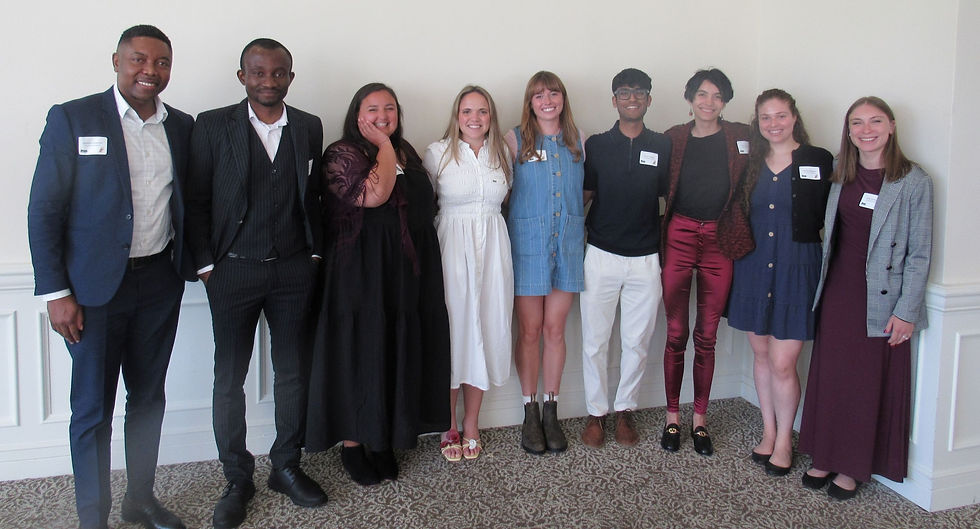
We were lucky enough to talk to many of them at TLCNJ's recent Gray Cup Invitational dinner last week. Now you can get to know these vibrant people, too!
Talia Barry is a third-year oceanography PhD student at Rutgers University. Her research explores the predator-prey relationships on oyster reef systems, identify ways oysters can be bred for stronger shells and also be made useful for restoration efforts. Talia's goal is to improve oyster resilience for better oyster restoration, coastal ecology, and coastal protection.
Jessica Beskind is a second-year master's student in environmental planning at Rutgers University. Rooted in her conservation and environmental science background, Jessica has worked on federal remediation projects across the country. Her current research examines the energy, water, waste, and land use impacts of hyperscale data centers on local communities. She also studies policy instruments to incentivize clean energy adoption in New Jersey. After graduate school, she hopes to use her expertise to advocate for healthy ecosystems and the communities they sustain.
Kyra Hall is pursuing a joint degree between Yale School of the Environment and Yale School of Management and will graduate with both a Master of Environmental Management (MEM) and Master of Business Administration (MBA) in 2028. She is developing both the technical and business skills to make informed decisions to do right by both business and climate, with an eye on creating realistic decarbonization plans for the private sector. Kyra graduated from Swarthmore College in 2022 with a B.A. in environmental studies, where she played varsity lacrosse, was heavily involved in sustainability leadership, and attended COP 26 in Glasgow as a student delegate.
Kathryn Marshall is pursuing a master’s degree in biology at Florida Atlantic University. Her research focuses on diamondback terrapin habitat and behavior in the Outer Banks, driven by a passion for wildlife research and management. In the future, Kathryn hopes to pursue a Ph.D. and build a career training the next generation of environmental scientists while contributing to the protection of coastal ecosystems.
Samuel Grant Quansah’s work focuses on protecting water and energy systems from cyber-physical threats. Before pursing an MS in cybersecurity at Montclair State University, Samuel spent more than 15 years managing major infrastructure and energy projects across Africa and the United Kingdom. His experience includes supporting water treatment systems serving rural communities in Ghana and contributing to offshore energy operations in environmentally sensitive marine environments. These experiences shaped his conviction that environmental sustainability, infrastructure resilience, and cybersecurity must be addressed together. Samuel plans to continue on to doctoral studies focused on securing critical energy and environmental infrastructure.
Jesse Rachelle will start at Duke University’s Nicholas School of the Environment in fall 2026 to pursue her Master of Environmental Management. She graduated from NYU in 2021, then led a variety of sustainability projects in corporate communications. After graduate school, Jesse hopes to work in federal government to help craft policies that more effectively regulate the private sector’s impact on the environment.
Kripa Shrestha is a PhD candidate in Environmental Science and Management at Montclair State University and a researcher at the Clean Energy and Sustainability Analytics Center (CESAC). Using climate models and machine learning, she studies how climate and land use contribute to losses and damage from increasing hazards such as floods, droughts, landslides, and wildfires. She hopes to advance science-based conservation and climate resilience strategies that help communities reduce climate-related loss and damage while protecting the natural systems they depend upon.
Odera Richard Umeh is a doctoral researcher in Environmental Science and Management at Montclair State University and a second-year recipient of a TLCNJ scholarship. His work confronts one of the state's most urgent environmental threats: per- and polyfluoroalkyl substances (PFAS), the "forever chemicals" contaminating New Jersey's water. Odera has mapped where these compounds occur and assessed the health risks they pose to children, pregnant women, and adults in order to help shape stronger remediation strategies and policy. It is work grounded in personal experience: growing up, he watched families struggle for clean, safe water and saw children fall ill. As an intern with New Jersey DEP's Water Resource Management Program, he helps protect the state's drinking water systems through compliance projects, regulatory work, and internal and external guidance. He has also rolled up his sleeves to volunteer with TLCNJ, the Great Swamp Watershed Association, and Wild Woods Restoration Project. Odera aims to become a leading voice at the intersection of environmental science, policy, and stewardship, turning research into remedy and knowledge into a cleaner, safer future for all New Jerseyans.
Sophie-Elizabeth (Lizzie) Villacampa is a rising senior at Rutgers University’s School of Environmental & Biological Sciences, majoring in Ecology, Evolution, & Natural Resources with a certificate in Environmental Geomatics. Lizzie is highly interested in movement and migration ecology, researching the impact of highway median barriers on wildlife mortality for their honors thesis. In the future, they would like to forge a career in migratory seabird research—their dream study species is the cryptic and endangered Marbled Murrelet (Brachyramphus marmoratus). Ultimately, Lizzie hopes that their life’s work may increase and maintain healthy habitat connectivity for wildlife across our rapidly changing planet.
Nat Yermack is a master's candidate in Earth and Planetary Sciences at Johns Hopkins University, investigating recent climate change-driven wildfire risk increases in the Black Forest of Germany (Schwarzwald). Inspired by a globetrotting childhood full of museum trips and nature documentaries, they've studied how Earth's systems worked and intertwined for as long as they can remember. Nat hopes that their current and future research will not only create a more resilient Schwarzwald, but also save more of Earth's critical environments and maintain a positive outlook in the face of anthropogenic climate change.


Comments